Panai Naar Kattil — The Traditional Tamil Cot Making a Comeback
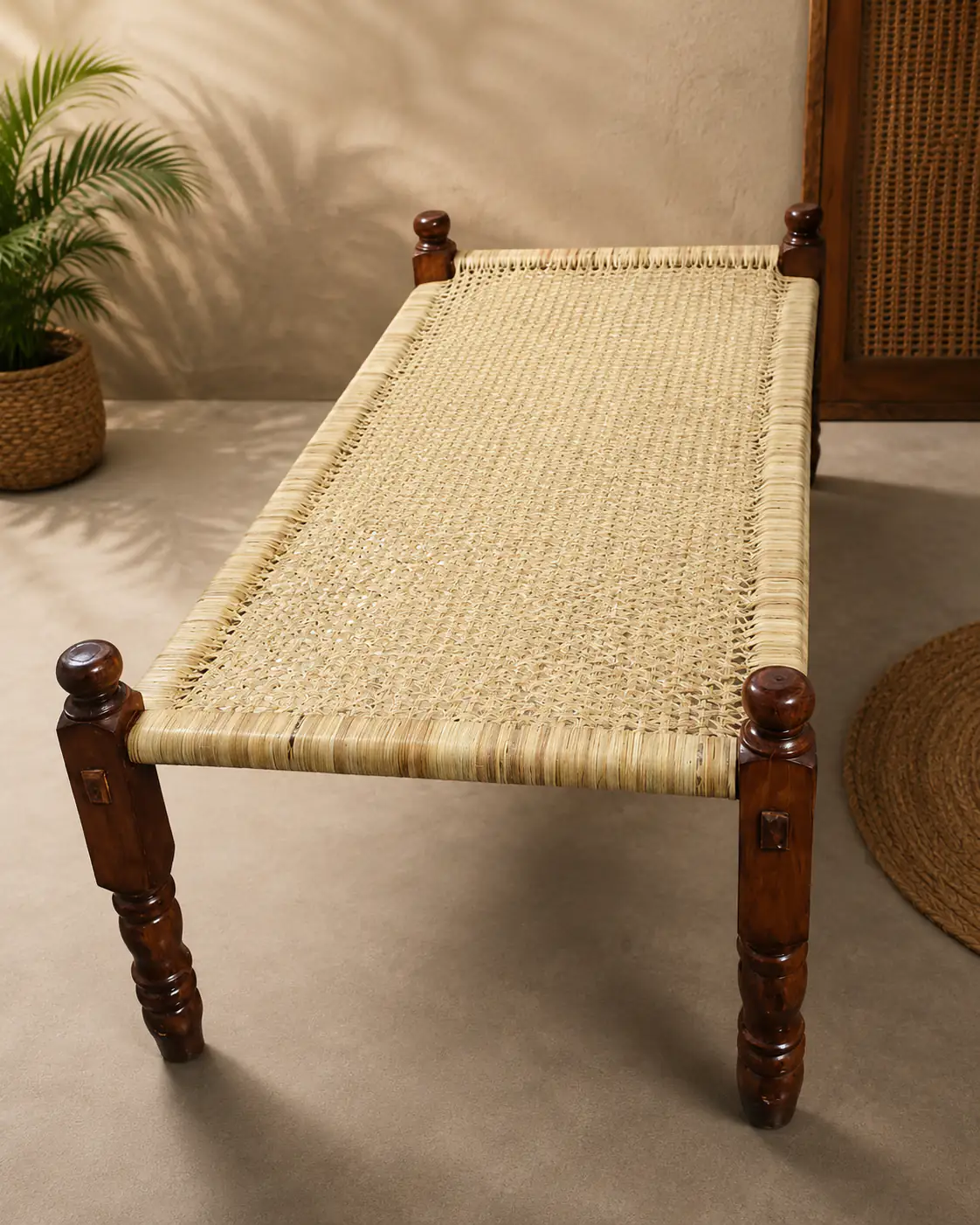
Ask anyone over fifty in a Tamil Nadu village what they slept on as a child, and most will describe the same thing: a wooden frame strung with woven palm leaf fiber, set up on the veranda through the hot months. The panai naar kattil — literally, "palm fiber cot" — was ordinary furniture in nearly every home for generations. It wasn't a craft object then. It was just what a bed was.
A craft passed down, not manufactured
Making a panai naar kattil is still, today, a hand process. The palm leaf fiber is processed and spun into rope by hand, then woven onto a wooden frame in a diamond pattern that has to be pulled tight and even — a skill that takes years to get right. There's no machine that replicates this weave at the quality a trained artisan produces. Every cot we make carries the small human irregularities that mark it as handmade, not stamped out of a factory.
Why it nearly disappeared
Foam mattresses arrived in Indian homes with a promise of softness and low price, and for a couple of decades the palm fiber cot slid out of everyday use — pushed to farmhouses, back rooms, and grandparents' houses. The artisans who knew the weave well kept working, but mostly for a shrinking, older customer base.
Why it's coming back
A few things changed at once. Families started noticing that the foam mattresses bought a decade ago sagged, held heat, and needed replacing — while the cot at the grandparents' house, made the old way, was still holding up fine after twenty years. At the same time, natural and sustainable materials became something people actively looked for, not just accepted. And there's a simpler pull too: for a lot of people, sleeping on a panai naar kattil again is genuinely nostalgic — it feels like their childhood summers.
- Durability that foam can't match — a well-made frame easily outlasts multiple mattress replacement cycles.
- A fully natural, biodegradable material with no synthetic foam or chemical treatment.
- Direct support for the artisans and the craft itself, which only survives if there's demand for it.
What we're trying to do at PalmCots
We work with artisans in Tamil Nadu who still weave by hand, pairing that traditional weave with solid teak or Poovarasam wood frames built for modern homes. The goal isn't a museum piece — it's a cot people actually sleep on every night, delivered to their door, built the way it always was.
See the handwoven cots we currently have available.
Browse Cots